Constant phase element, model character p. More...
#include <constantphase.h>
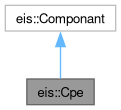
Inherits eis::Componant.
Public Member Functions | |
| Cpe (std::string paramStr, size_t count=10, bool defaultToRange=false) | |
| Cpe (fvalue q, fvalue alpha) | |
| virtual std::complex< fvalue > | execute (fvalue omega) override |
| virtual size_t | paramCount () const override |
| virtual char | getComponantChar () const override |
| virtual std::string | componantName () const override |
| virtual std::vector< eis::Range > | getDefaultParameters (bool range=true) const override |
| virtual std::string | getCode (std::vector< std::string > ¶meters) override |
| virtual std::string | getTorchScript (std::vector< std::string > ¶meters) override |
| Public Member Functions inherited from eis::Componant | |
| virtual void | setParamRanges (const std::vector< eis::Range > &ranges) |
| virtual std::vector< eis::Range > & | getParamRanges () |
| virtual std::vector< eis::Range > | getParamRanges () const |
| virtual std::string | getComponantString (bool currentValue=true, bool withCount=false) const |
| Gets this componant as a model string. | |
| virtual bool | compileable () |
| std::string | getUniqueName () |
| bool | hasDefaultedParameters () const |
| Checks if this componant had to use default parameters. | |
Static Public Member Functions | |
| static constexpr char | staticGetComponantChar () |
| Static Public Member Functions inherited from eis::Componant | |
| static Componant * | copy (Componant *componant) |
| static Componant * | createNewComponant (char componant, std::string paramStr="", size_t count=1, bool defaultToRange=false) |
| static bool | isValidComponantChar (char componant) |
Additional Inherited Members | |
| Protected Member Functions inherited from eis::Componant | |
| void | initRanges (const std::string ¶mStr, size_t count, bool defaultToRange) |
| Protected Attributes inherited from eis::Componant | |
| std::vector< eis::Range > | ranges |
| std::string | uniqueName |
| bool | defaultedParameters = false |
Detailed Description
Constant phase element, model character p.
Parameters: p{Q,alpha}
- Q : admittance coefficient (often Y0 or T) in S s^alpha
- alpha : exponent, dimensionless, conventionally 0 <= alpha <= 1
The general element of which the others are special cases. Substituting an exponent turns p into a different element exactly:
Because of these identities a p whose exponent sits on one of those values is interchangeable with the corresponding element; eis::Model::getEquivalentParameterPermutations() finds them by fitting rather than by comparing model characters.
Numerically the real and imaginary parts are computed as separate cos and sin terms, so at alpha = 1 the real part is not exactly zero but about 6e-17 / (Q omega), the rounding of cos(pi/2). Harmless for spectra, but do not test Re(Z) == 0 against a p.
alpha is the least sensitive parameter in a model string and Q the most, which matters when budgeting sweep steps; see the find-range mode.
Member Function Documentation
◆ componantName()
|
inlineoverridevirtual |
Implements eis::Componant.
◆ execute()
|
overridevirtual |
Reimplemented from eis::Componant.
◆ getCode()
|
overridevirtual |
Reimplemented from eis::Componant.
◆ getComponantChar()
|
overridevirtual |
Implements eis::Componant.
◆ getDefaultParameters()
|
overridevirtual |
Reimplemented from eis::Componant.
◆ getTorchScript()
|
overridevirtual |
Reimplemented from eis::Componant.
◆ paramCount()
|
overridevirtual |
Reimplemented from eis::Componant.
Generated by
 1.18.0