eis::Resistor Class Reference
Ideal resistor, model character r. More...
#include <resistor.h>
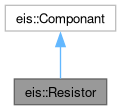
Inherits eis::Componant.
Collaboration diagram for eis::Resistor:
Public Member Functions | |
| Resistor (fvalue r) | |
| Resistor (std::string paramStr, size_t count=10, bool defaultToRange=false) | |
| virtual std::complex< fvalue > | execute (fvalue omega) override |
| virtual size_t | paramCount () const override |
| virtual char | getComponantChar () const override |
| virtual std::string | componantName () const override |
| virtual std::string | getCode (std::vector< std::string > ¶meters) override |
| virtual std::vector< eis::Range > | getDefaultParameters (bool range=true) const override |
| virtual std::string | getTorchScript (std::vector< std::string > ¶meters) override |
| Public Member Functions inherited from eis::Componant | |
| virtual void | setParamRanges (const std::vector< eis::Range > &ranges) |
| virtual std::vector< eis::Range > & | getParamRanges () |
| virtual std::vector< eis::Range > | getParamRanges () const |
| virtual std::string | getComponantString (bool currentValue=true, bool withCount=false) const |
| Gets this componant as a model string. | |
| virtual bool | compileable () |
| std::string | getUniqueName () |
| bool | hasDefaultedParameters () const |
| Checks if this componant had to use default parameters. | |
Static Public Member Functions | |
| static constexpr char | staticGetComponantChar () |
| Static Public Member Functions inherited from eis::Componant | |
| static Componant * | copy (Componant *componant) |
| static Componant * | createNewComponant (char componant, std::string paramStr="", size_t count=1, bool defaultToRange=false) |
| static bool | isValidComponantChar (char componant) |
Additional Inherited Members | |
| Protected Member Functions inherited from eis::Componant | |
| void | initRanges (const std::string ¶mStr, size_t count, bool defaultToRange) |
| Protected Attributes inherited from eis::Componant | |
| std::vector< eis::Range > | ranges |
| std::string | uniqueName |
| bool | defaultedParameters = false |
Detailed Description
Ideal resistor, model character r.
Z(omega) = R
Parameters: r{R}
- R : resistance in Ohm
Frequency independent, imaginary part is exactly zero. See Model Format for the sign and frequency conventions all elements follow.
Two resistors in series, or two in parallel, are not separately identifiable: only the sum (respectively the parallel combination) shows in the spectrum. eis::Model::getEquivalentParameterPermutations() reports that degeneracy.
Member Function Documentation
◆ componantName()
|
inlineoverridevirtual |
Implements eis::Componant.
◆ execute()
|
overridevirtual |
Reimplemented from eis::Componant.
◆ getCode()
|
overridevirtual |
Reimplemented from eis::Componant.
◆ getComponantChar()
|
overridevirtual |
Implements eis::Componant.
◆ getDefaultParameters()
|
overridevirtual |
Reimplemented from eis::Componant.
◆ getTorchScript()
|
overridevirtual |
Reimplemented from eis::Componant.
◆ paramCount()
|
overridevirtual |
Reimplemented from eis::Componant.
Generated by
 1.18.0