|
|
| TransmissionLineOpen (fvalue r, fvalue q, fvalue a, fvalue l) |
|
| TransmissionLineOpen (std::string paramStr, size_t count=10, bool defaultToRange=false) |
|
| TransmissionLineOpen (const TransmissionLineOpen &in) |
| virtual std::complex< fvalue > | execute (fvalue omega) override |
| virtual size_t | paramCount () const override |
| virtual std::vector< eis::Range > | getDefaultParameters (bool range=true) const override |
| virtual char | getComponantChar () const override |
| virtual std::string | getCode (std::vector< std::string > ¶meters) override |
| virtual std::string | componantName () const override |
|
virtual void | setParamRanges (const std::vector< eis::Range > &ranges) |
|
virtual std::vector< eis::Range > & | getParamRanges () |
|
virtual std::vector< eis::Range > | getParamRanges () const |
| virtual std::string | getComponantString (bool currentValue=true, bool withCount=false) const |
| | Gets this componant as a model string.
|
|
virtual std::string | getTorchScript (std::vector< std::string > ¶meters) |
|
virtual bool | compileable () |
|
std::string | getUniqueName () |
| bool | hasDefaultedParameters () const |
| | Checks if this componant had to use default parameters.
|
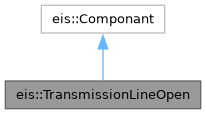
Transmission line with an open (reflecting) end, model character o.
Z0 = sqrt( R / (Q (j omega)^alpha) ) characteristic impedance
gamma = sqrt( (j omega)^alpha R Q ) propagation constant
Z(omega) = Z0 / tanh(gamma l) = Z0 coth(gamma l)
gamma l << 1 Z -> 1 / (l Q (j omega)^alpha) CPE-like, total admittance l Q
gamma l >> 1 Z -> Z0 = sqrt(R/Q) (j omega)^(-alpha/2) CPE-like, exponent alpha/2
Parameters: o{R,Q,alpha,l}
- R : line resistance per unit length in Ohm m^-1
- Q : line admittance coefficient per unit length in S s^alpha m^-1
- alpha : exponent of the distributed admittance, dimensionless
- l : line length, in the length unit R and Q are quoted per
The complement of TransmissionLineClosed: the end reflects instead of shorting, so at DC the line reads as its total distributed admittance l Q (a capacitance l Q when alpha = 1) and the impedance diverges, whereas t converges to R l. Above gamma l >> 1 the two coincide, so telling them apart needs low-frequency data.
Like t this element is poorly conditioned to fit and is deliberately excluded from eis::Model::getEquivalentParameterPermutations().
 1.18.0